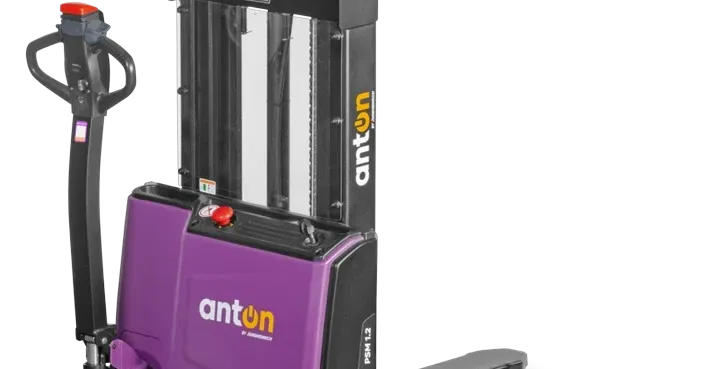
A stacker is chosen on four numbers: lift height, capacity at that height, working aisle width, and the machine's height in transport position. Get any one of them wrong and the machine stands idle.
Lift height: measure to the shelf, not the ceiling
The height you need is the top shelf plus roughly 150 mm, so the pallet clears the beam and settles into place. If the top level is at 3,200 mm, a machine lifting 3,300 mm works at its limit: an uneven floor is enough for the pallet to catch the beam.
Residual capacity
"1,200 kg" on the machine means capacity at minimum lift and a standard load centre, usually 600 mm. The higher the forks go, the less the machine holds safely. The manufacturer publishes a chart — that is the thing to read.
| Lift height | PSM 1.2 (1,200 kg) | PSM 1.6 (1,600 kg) |
|---|---|---|
| to 1,600 mm | 1,200 kg | 1,600 kg |
| 2,500 mm | 1,200 kg | 1,600 kg |
| 3,300 mm | 1,000 kg | 1,400 kg |
| 4,200 mm | 800 kg | 1,200 kg |
| 5,000 mm | — | 1,000 kg |
The practical conclusion is simple: if your top level holds 1,000 kg pallets, a machine "rated 1,200" is not for you. Take the next size up.
Aisle width
The manufacturer calculates working aisle width for a 800×1200 mm euro pallet carried lengthways. If you carry pallets crossways or work with non-standard loads, add the difference in dimension to the published figure — otherwise the machine physically will not turn in your aisle.
For a warehouse with aisles narrower than 2.3 m a pedestrian stacker is already awkward: look at reach trucks or narrow-aisle equipment instead.
Pedestrian or stand-on
A pedestrian machine is cheaper and more compact, but the operator walks. Over 40 to 50 metres a trip that starts to cost productivity. A model with a folding platform adds to the footprint, but the operator rides — and in a long warehouse it pays for itself within months.